Everything You Need to Know About Car Maintenance After 100,000 Miles
Table of Contents
For many drivers, hitting the 100K mark feels like a worrying milestone. Some are convinced that once the odometer hits this figure, it is time to sell the car immediately. Others simply keep driving without making a big deal out of it. The truth, as usual, lies somewhere in between.
A mileage of 100,000 does not mean the end of your vehicle; modern cars are capable of covering far greater distances. However, according to statistics, after this point, issues that often begin to surface may cost a penny - problems stemming from components that had previously been quietly wearing down.
The Indy Auto Man mechanics explain how your car is demanding attention at 100 miles, and what costly components you need to check after this milestone.
The main thing to understand about car maintenance right away
The "whole car" doesn't just fall apart at once after 100,000 miles. Usually, specific parts having simply reached the end of their service life begin to fail gradually.
This is where factors beyond just mileage come into play; the car's history matters just as much:
- driving conditions;
- whether it was serviced on time;
- schedule of fluid changes;
- any postponed repairs;
- how often the car sat in traffic or operated under heavy loads.
The same model might still be running strong for one owner after 100K miles, while requiring significant investment for another.
What to check after the 100,000-mile mark
If your car has reached this milestone, it is worth inspecting the following:
- suspension;
- brakes;
- steering system;
- cooling system;
- belts and pulleys;
- battery condition;
- transmission;
- fluid leaks;
- spark plugs and ignition coils;
- sensors and electronics.
This is a classic case where preventive maintenance is almost always cheaper than reactive repairs.
Suspension: a prime candidate for issues after 100K
This is perhaps the most common scenario. After 100,000 miles, the suspension frequently demands attention.
Typically, the first parts to wear out are:
- stabilizer links;
- bushings;
- control arm bushings (silent blocks);
- ball joints;
- shock absorbers;
- wheel bearings;
- tie rod ends.
At first, this may show up as knocking, creaking, or humming, or simply as the feeling that the car no longer handles as tightly as it used to. If you don't address the issue promptly, one failing part often leads to a chain reaction involving others.
Brakes are no longer "like new"
After the 100,000-mile mark, the braking system often requires more than just new pads. At this mileage, brake discs frequently reach the end of their service life, calipers may start to bind, hoses age, and brake fluid loses its effectiveness.
That is precisely why, beyond this point, the assumption that "it just needs new pads" doesn't always hold true; sometimes, more extensive maintenance is actually required.
The steering system starts to show its age after 100K
Another typical trouble spot after 100,000 miles is the steering system. Play in the steering, knocking sounds, a loss of precision, fluid leaks, and a general feeling that the car has lost its composure often appear during this period.
This is especially noticeable in cars that have seen heavy use on rough roads. Suspension and steering components rarely wear out in isolation - usually, they deteriorate together.
Belts, pulleys, and the water pump - areas where skimping is a mistake
Around the 100,000-mile mark, many vehicles are due for timing belt, pulley, accessory drive belt, and sometimes water pump replacement. This is a situation where delaying maintenance is particularly risky.
If a driver puts off the replacement "just a little longer" and the belt snaps, the issue shifts from routine maintenance to a major engine repair.
The ignition system starts demanding attention
In gasoline-powered cars, spark plugs, ignition coils, and other ignition components often begin to malfunction after 100,000 miles. The car may still be drivable, but it might start harder, misfire, jerk, or lose power.
At first, these issues might seem trivial. Yet these "minor" problems often trigger a chain reaction that leads to more significant issues.
Electrical systems and sensors: classic issues for aging cars
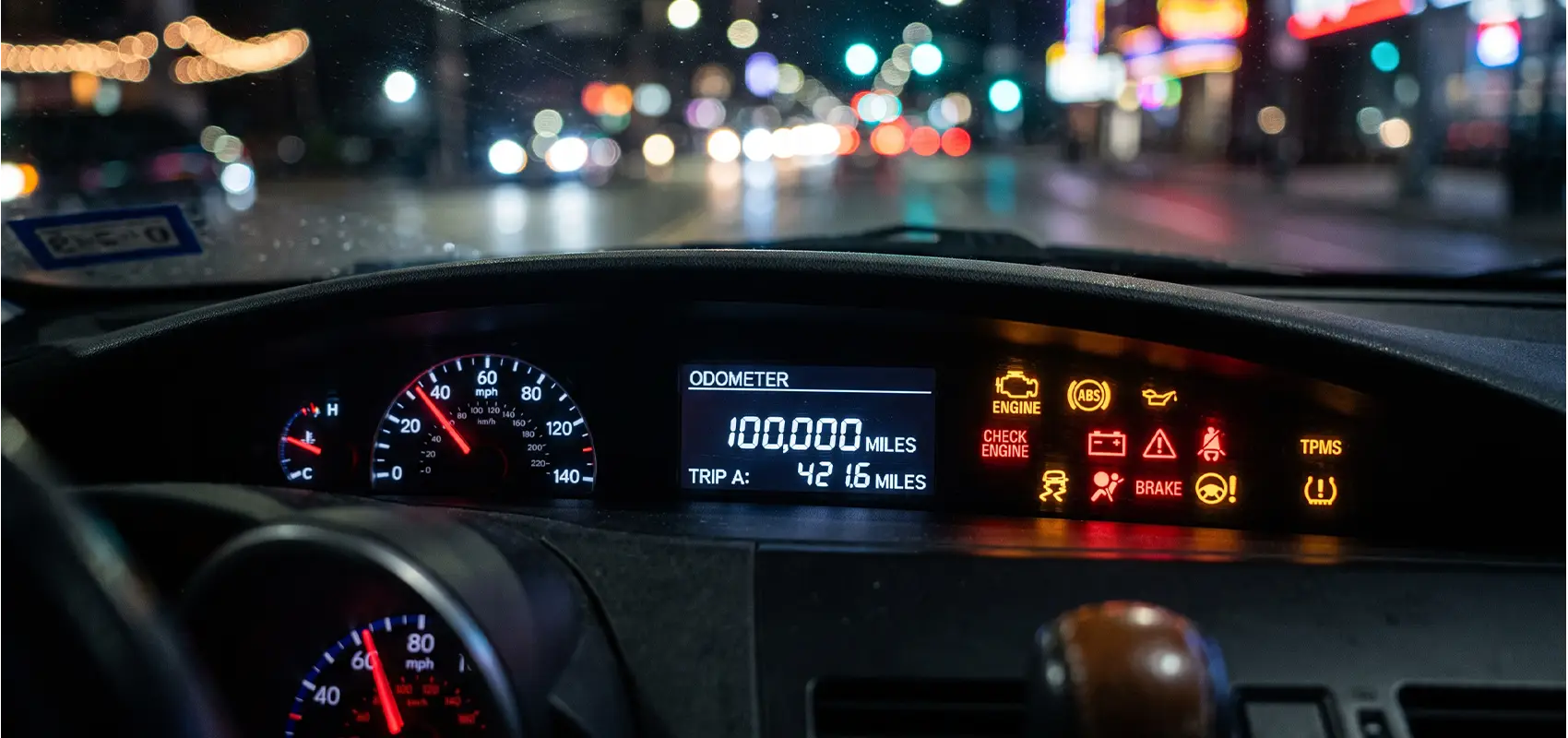
This is a familiar scenario for owners of high-mileage vehicles. Once the odometer passes the 100,000 mark, it is rarely one major component that fails; instead, a host of small issues often crop up simultaneously.
- a sensor starts giving incorrect readings;
- the door lock becomes intermittent;
- contacts corrode;
- strange error codes appear;
- the battery weakens;
- the alternator loses some of its original pep.
These issues aren't always expensive to fix, but they are almost always annoying.
The cooling system maintenance after 100,000
Other potential trouble spots include the radiator, hoses, thermostat, connections, and water pump. Everything may work flawlessly up to a point, but after 100,000 miles, the system's age begins to show.
The problem is that many owners only think about the cooling system after the engine has already overheated, which is hardly the ideal starting point for diagnostics.
Engine and transmission mounts wear out too
This is a frequently overlooked issue. When mounts lose their effectiveness, the car’s behavior becomes rougher:
- vibrations appear;
- jerking occurs when pulling away;
- clunking happens during gear shifts;
- unusual noises develop;
- the car feels stiffer or less refined.
At this stage, many owners suspect a transmission or engine failure, when the actual culprit is simply the mounts.
The transmission may also start acting up
With manual transmissions, the clutch often needs replacing after the 100,000-mile mark. With automatics, this is the mileage where the consequences of poor maintenance often surface: degraded fluid, initial jerking, delays, harsh shifting, and noise.
Not in every case or all the time, of course. But if the transmission has long been maintained on the "if it’s running, don’t touch it" principle, problems often surface after 100K.
The exhaust and fuel systems are also at risk
Fuel injectors, the fuel pump, filters, the throttle body, lambda sensors, the catalytic converter, and the exhaust flex pipe - all of these components may already require attention.
Typical symptoms include:
- hard starting;
- rough idling;
- loss of power;
- increased fuel consumption;
- unusual noises;
- mixture-related error codes.
In other words, the car still runs, but not as effortlessly or confidently as before.
Should you be afraid of the 100,000-mile mark?

You shouldn't fear the number on the odometer, but rather poor maintenance. A well-maintained car with 100,000–150,000 miles on the clock is often a better choice than a trashed vehicle showing an attractive 60,000 miles.
Reaching 100,000 miles is not a cause for panic, but rather a time to pay closer attention to the vehicle. This is precisely the stage when it pays to do proper diagnostics and preventive maintenance rather than waiting for a major breakdown to occur.
Schedule your visit to the Indy Auto Man service station in Indianapolis or Westfield to keep your vehicle running reliably for a long time.